Medication Intelligence
Without Doubt or Disruption


Sensor-verified dose data. Without changing how patients live or how sites operate.

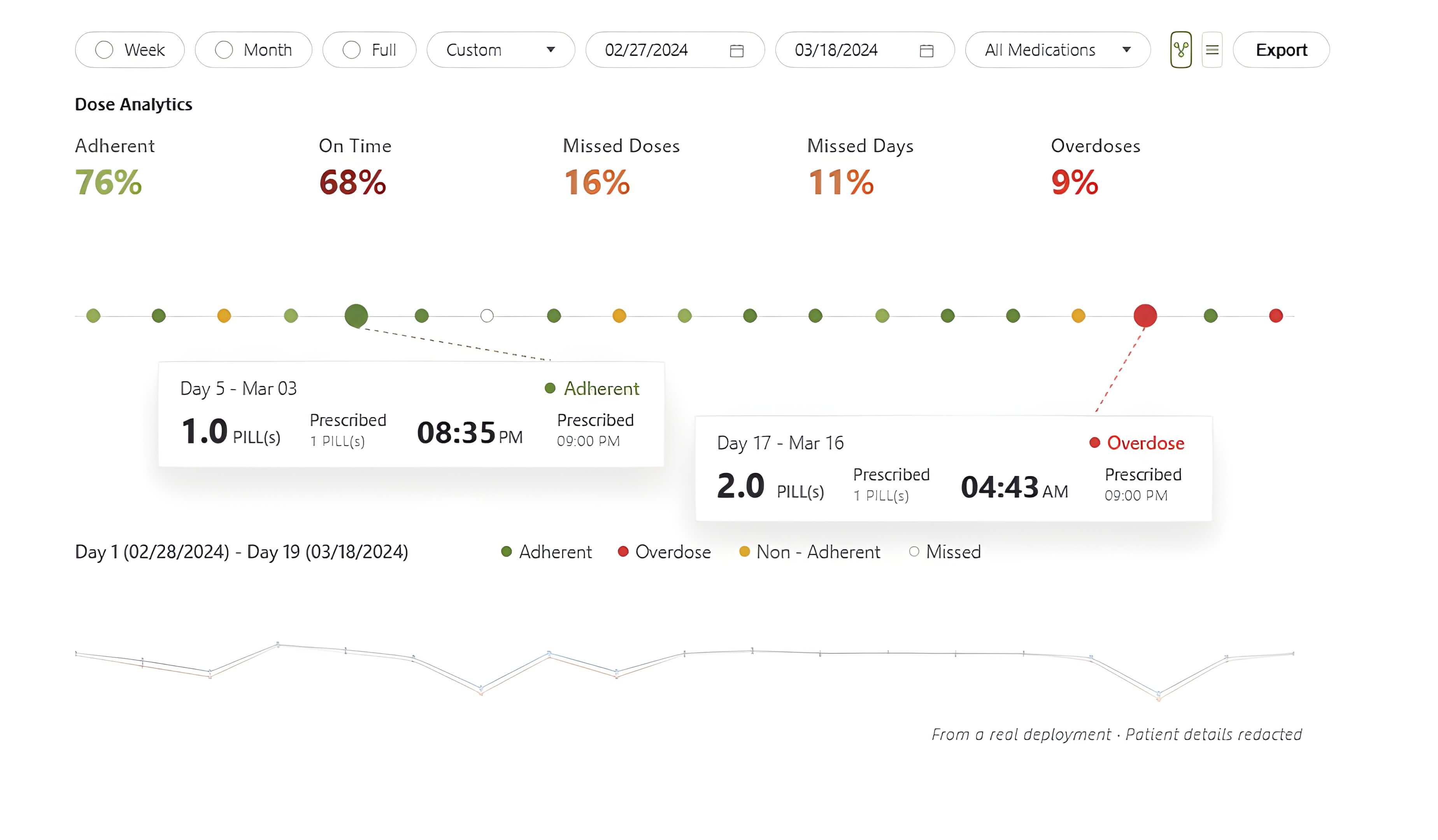
Adherence dashboard showing dose-by-dose distribution across patients
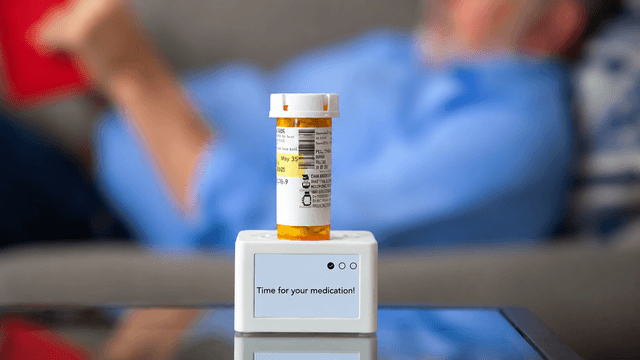
Smart Dock device on countertop with pharmacy vial

The field measures adherence events. It does not measure dose.

Pill caps tell you a bottle was opened, not how many tablets came out. Refill records produce PDC, which tells you a prescription was filled, not whether the regimen was followed. App check-ins tell you a patient responded, not whether the dose was taken. Topical diaries tell you a tube was used, not how much was applied.

What proxies infer.
What MyAide measures.

Two scenarios: what happened, what a proxy monitor records, and what MyAide measures.

Verified Overdose Missed
Proxy tech · Pill cap

Dose taper failure.

2 tablets daily, days 1–5.
Taper to 1 tablet, days 6–7.
Patient does not taper.

D1D2D3D4D5
taper
D6
D7
Prescribed 2 2 2 2 2 1 1
Actual 2 2 2 2 2 2 2
Proxy
MyAide 2 2 2 2 2 2 2

Proxy monitor

Taper failure invisible. Full compliance reported.

MyAide

Overdose flagged days 6–7. Clinician alerted before day 8.

Underdose Overdose Missed
Patient app · Self-report

Ointment underapplied.

4 ftu prescribed daily.
Patient applies 2 ftu most days.
8 ftu on one day.

D1D2D3D4D5D6D7
Prescribed 4 4 4 4 4 4 4
Actual 2 2 2 2 8 2 2
Proxy
MyAide 2 2 2 2 8 2 2

Proxy monitor

All seven days logged as applied. Quantity never measured.

MyAide

6 under-doses, 1 over-dose detected. Measured to 0.2g accuracy.

See more ways MyAide captures what proxy systems cannot →

Where the margin between effect and failure is narrow, that gap is not tolerable

In tacrolimus, methotrexate, and warfarin, the difference between control and the next adverse event is a 20% deviation.

In short half-life CNS therapies, adherence drift is invisible until a patient on clozapine or lithium decompensates.

In high-acuity dermatology, complex topical regimens for intractable plaque psoriasis collapse silently outside the clinic.

Proxy-grade data is not enough.

Who we work with

01

Clinical Trials and Decentralized Trials

Phase 2–4 sponsors and CROs that need adherence data able to withstand regulatory scrutiny. Across oral, topical, and other dosage forms.

For sponsors and CROs →
02

Pharma Medical Affairs and HEOR

Real-world evidence and outcomes research teams connecting medication behavior to PASI, A1c, or therapy response, with a precision claims data cannot support.

For Medical Affairs →
03

Complex Therapy Management

Transplant, oncology, dermatology, and complex therapy programs where dose-level precision is the difference between a useful signal and a guess.

For specialty programs →

Our record to date

New randomized evidence

A 2026 randomized trial in the Journal of the American Academy of Dermatology found that sensor-verified dose-quantity monitoring improved patient adherence to both the prescribed frequency and the prescribed amount in psoriasis patients. Read the study.

10,000+
Dispense daysAcross solid oral and topical dosage forms.
94–100%
Dose-quantity agreementIndependent validation. Smart Dock 100% (University of Houston), Smart Cap 94% within 0.2g.
4 / 9
Patents · countriesTwo additional patents pending.
4.7/5
Patient ease of use ratingsReal-world use across pilot programs.
20+
Scientific ContributionsPeer-reviewed publications and conference presentations.

Validated across independent academic and industry-funded studies.