Medication engagement models operate under constraints: their scope extends only as far as the data on which they run. A system cannot engage a patient more precisely than the medication parameters it measures.
MyAide therefore was built from a different foundation. Our sensor-based Smart Dock and Smart Cap measure the dose itself, at every dispensing event, to 0.2 grams. The MyAide dashboard reports three measures separately: whether a dose was dispensed, whether it was dispensed on time, and whether it was the right amount. Our databases capture the number of pills dispensed, whether there was an overdose or an underdose, and if so, by how much. For topicals, that precision is even more critical, since patients are more likely to diverge from prescribed amounts of topicals than from prescribed doses, contributing to suboptimal outcomes. We do not collapse these into a single adherence score, because a clinician acting on the data needs to know which of the three is the problem. But the measures can be synthesized into composite adherence, if needed.
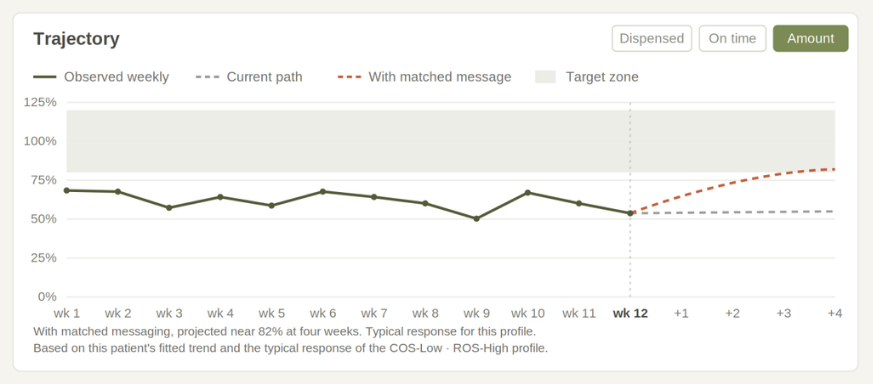
Synthetic patient. Illustrative, not clinically reviewed. Sensal Health, July 2026.
That measurement layer is now becoming a learning layer with our AI augmented dashboard. The next release of MyAide augments existing intelligence with a model that reads each patient’s dosing pattern alongside a behavioral classification made at enrollment. The classification is based on well-established constructs, some directly measured by Steve Feldman in his research and by Deepak in his, and some that exist adjacent to them. It reflects how a patient is oriented to their own care: some patients are deeply invested and close to their care team, some prefer to manage their health their own way, some follow their regimen because they have to. Precise engagement emerges from using engagement methods that match patients’ orientation and receptivity.
Under the hood, MyAide separates what should be deterministic from what should be intelligent. Everything a patient sees is deterministic: dose events are captured by the sensors, quantized per dose, and matched through a fixed lookup architecture to a message library that was written, reviewed, and approved in advance. The same inputs always produce the same message, which means the patient-facing layer is auditable line by line, there is no generative content in the loop, and a clinician reviews before anything is sent. This continues our firm belief that our greatest impact, particularly for complex and challenging regimens, is made when we enable great clinicians, including pharmacists, nurses, and physicians, to do their jobs.
The intelligence sits behind that boundary. An agentic layer, built on the Strands Agents SDK, orchestrates the clinician-facing work: reading dosing trajectories, projecting where a patient’s pattern is heading using least-squares fitting weighted by behavioral profile, and assembling the context a care team needs before anything goes out. AI does the reasoning while the deterministic core does the talking. That division is a design decision because in medication engagement the cost of a wrong message is carried by a patient.
In the end, our differentiation compounds here. A model is only as distinctive as the data it learns from, and dose-quantity data at this resolution has not existed before. The model inherits that distinctiveness. Where the sensors gave us precise measurement, the model turns precise measurement into precise engagement, and each strengthens the case for the other.
For clinical trials, this means dose-quantity evidence paired with engagement that protects protocol fidelity patient by patient. For clinical care, it means outreach that reflects what a patient actually dispensed and who that patient actually is. In both settings, we are proud to offer a method for precise engagement, and we would be glad to show it to you.
Medication Intelligence. Without Doubt or Disruption.