AI and machine learning models of patient adherence are only going to be as good as the data they are built on. Whether that data feeds a trajectory or a logistic regression model, its reliability is what defines the result.
With this in mind, and with a founding team that has decades of experience commissioning clinical research and analyzing the outputs of adherence studies, we built MyAide’s foundational adherence signals from the actual quantities dispensed by patients, regardless of the form of the medication (solid oral, ointments, creams, and so on).
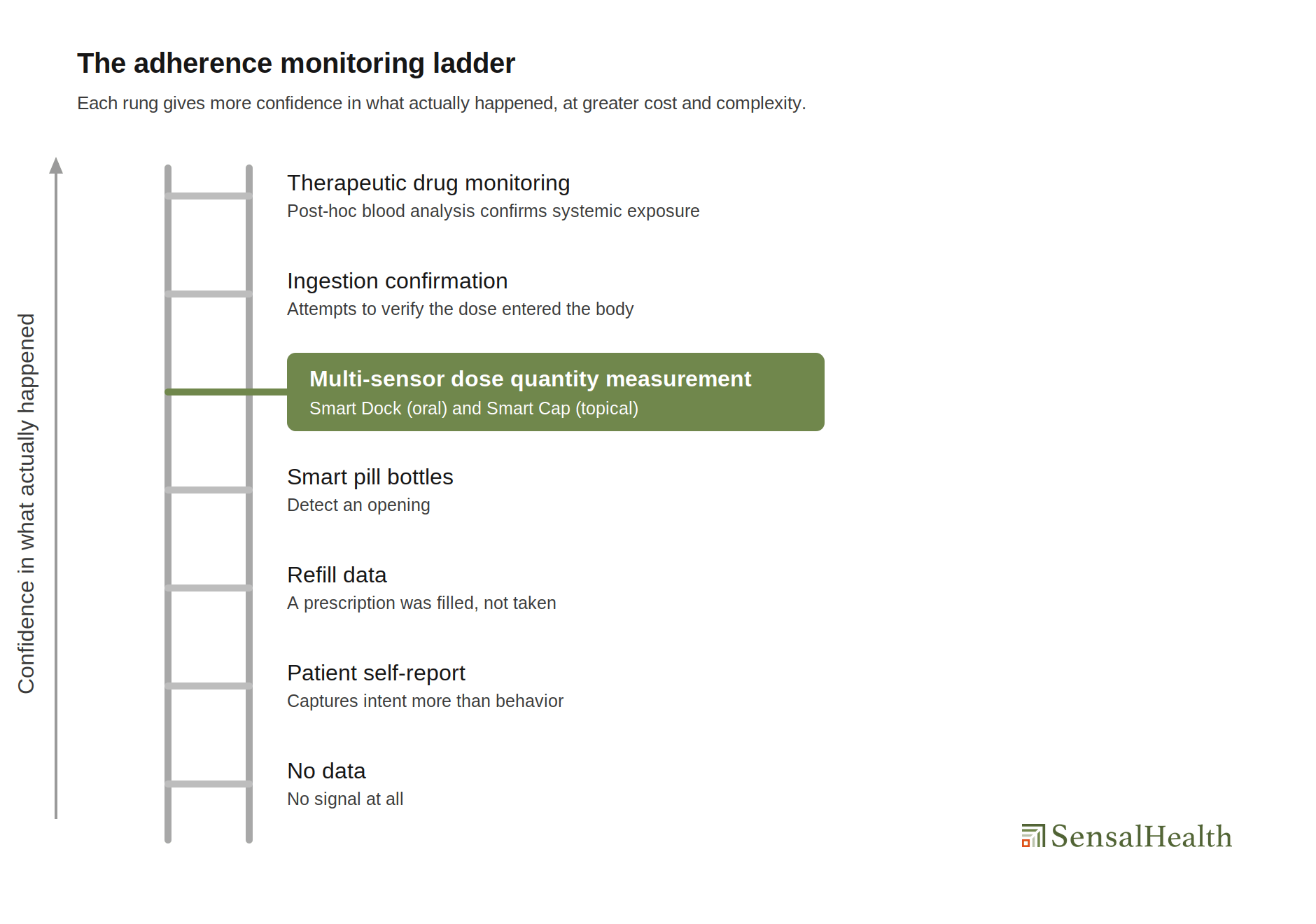
The lower rungs show commonly used methods that we decided not to pursue for our builds, given our concerns about their reliability. For example, in our lifetime, some of us have conducted more patient surveys than we care to remember. Correcting for biases was a nightmare and a job in itself.
On the other hand, verified ingestion of a medication, while the ultimate proof of dosage, has been a bridge too far for the industry. As a relatively small firm, we studied those attempts carefully, and we set our sights on the highest rung we could build on responsibly.
That meant quantity-level verification, the precise measurement of how much medication was actually removed from the container at the time of use. For oral medications, our Smart Dock does this. For topical medications, our Smart Cap does this, and for topicals, nothing comparable exists anywhere in the market today. It took us far more time, and more iterations than planned, but validation against our target parameters, at 94%, bears out the investment (see validation papers).
Where this matters most shows up in the conditions least forgiving of guesswork, as a recent post from my colleague Ramesh(Reliable Adherence Insights For Narrow Therapeutic Index Drugs) explains. Consider direct oral anticoagulants. Their short half-life means a missed dose quickly erodes protection against stroke, and unlike older agents they carry no routine blood test to reveal that a patient has begun to drift. A refill record cannot separate the patient who doses faithfully from the one who fills on schedule and takes the drug erratically. Quantity-level data can, because our devices measure how much was actually removed, dose by dose, while a pattern is still early enough to act on.
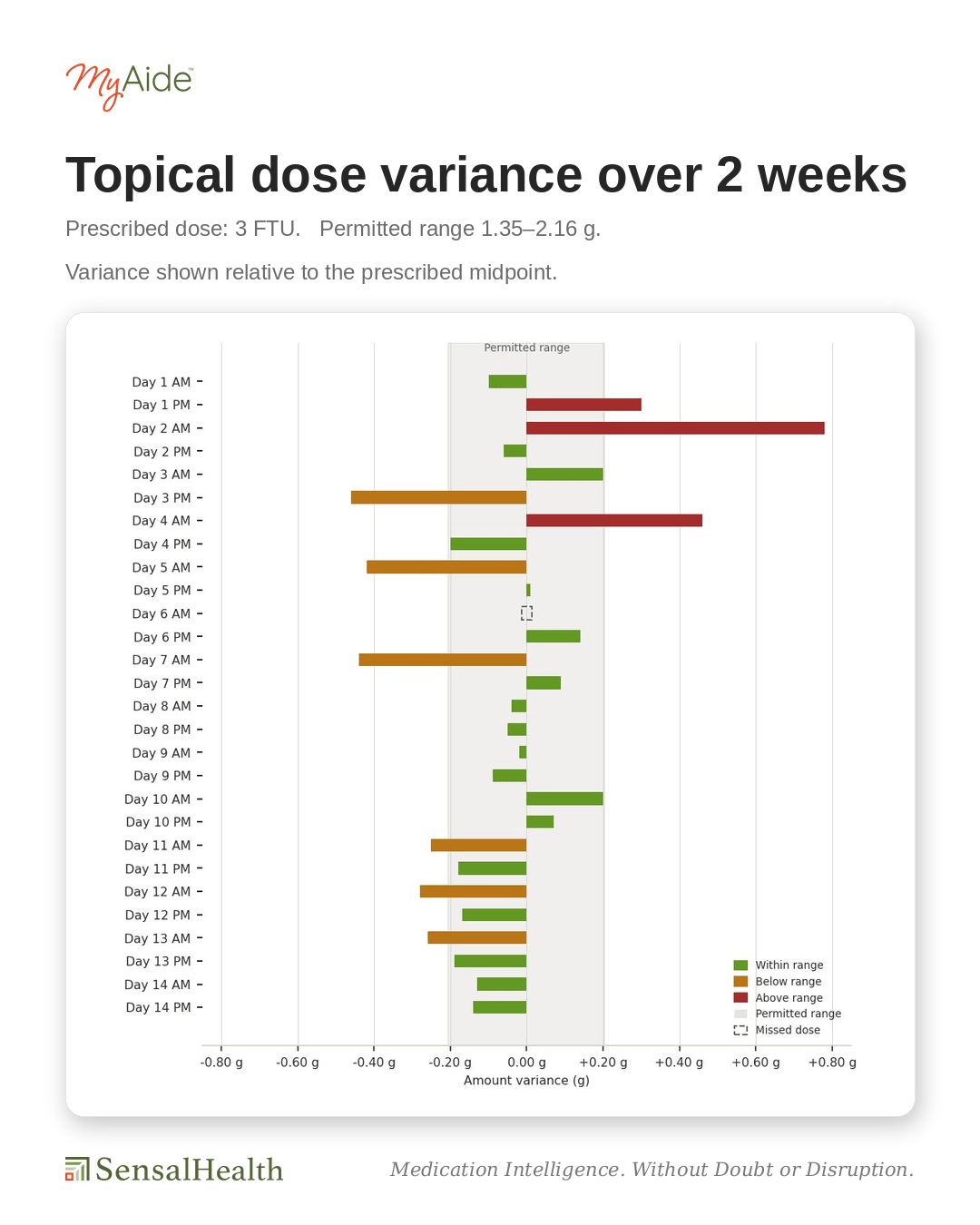
Topical therapy poses the opposite problem and the same need, as our dermatology expert Steve Feldman knows well. In psoriasis, treatment fails far more often from too little medication applied too inconsistently than from any shortcoming of the drug, yet how much a patient actually applies has long been visible to no one but the patient. Our devices turn that quantity into a measured insight for patients and clinicians.
Medication Intelligence Built on that Foundation
MyAide is the medication intelligence platform we are building on that foundation. It brings quantity-verified adherence signals from Smart Dock and Smart Cap together with patient-reported data through the MyAide app, so that raw behavioral data can become something clinically meaningful. The intelligence layer is where dosing parameters become useful, and it is the part we are building now. It is designed to support engagement grounded in actual observed behavior, and to model adherence trajectories, risk patterns, and population-level signal for clinical research.
We are building this system through collaborations and partnerships, so that patients, clinicians, pharma, and payers can efficiently improve clinical outcomes and promote patient well-being.