Medication Intelligence
Without Doubt or Disruption


Sensor-verified dose data. Without changing how patients live or how sites operate.

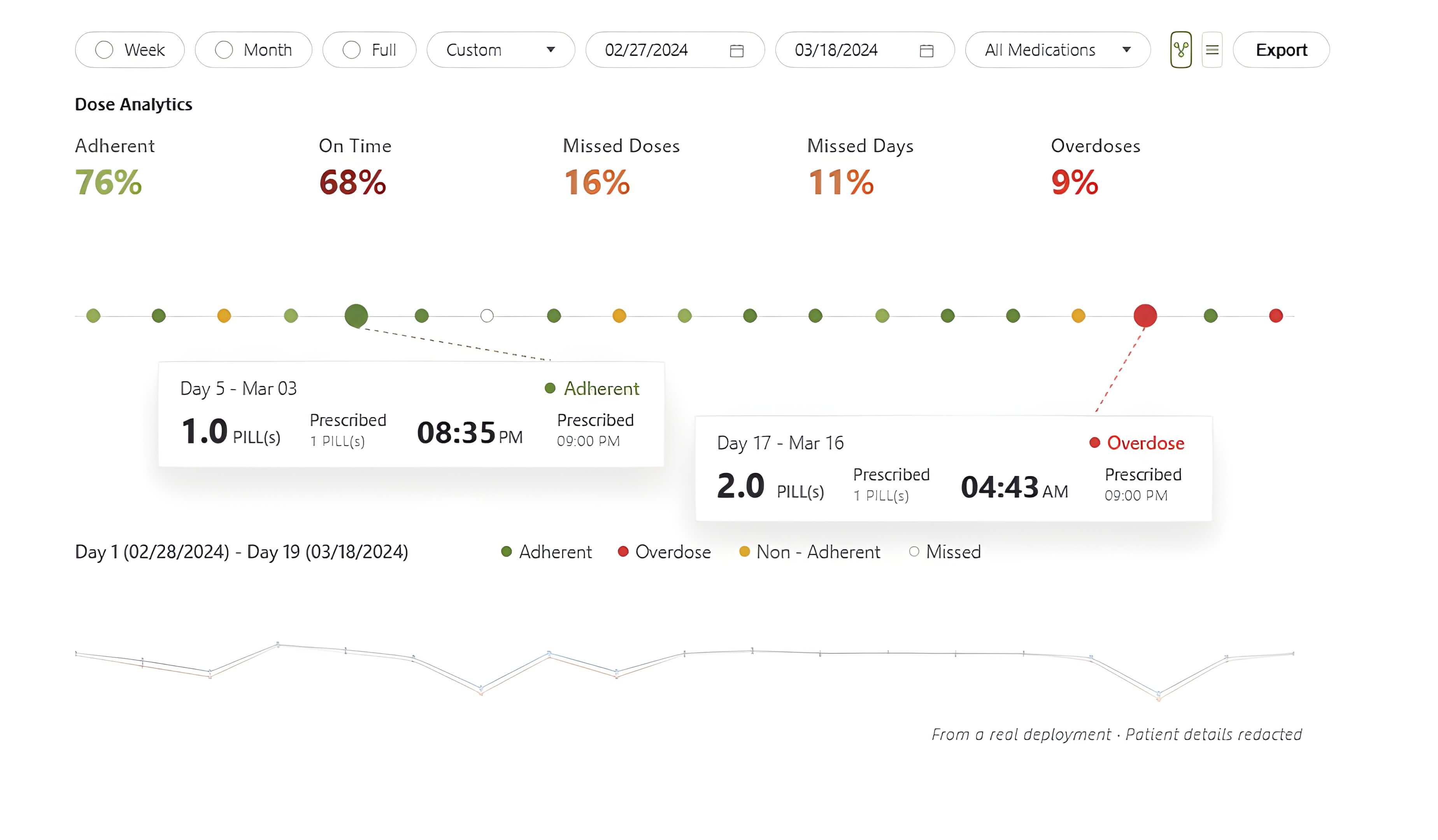
Adherence dashboard showing dose-by-dose distribution across patients
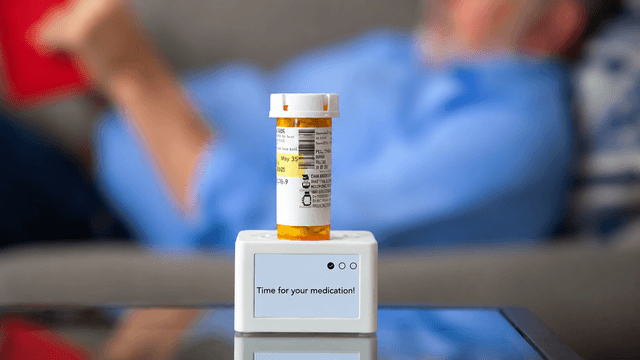
Smart Dock device on countertop with pharmacy vial

The field measures adherence events. It does not measure dose.

Pill caps tell you a bottle was opened, not how many tablets came out. Refill records produce PDC, which tells you a prescription was filled, not whether the regimen was followed. App check-ins tell you a patient responded, not whether the dose was taken. Topical diaries tell you a tube was used, not how much was applied.

What proxies infer.
What MyAide measures.

Two scenarios. Same week — three ways: what actually happened, what a proxy monitor records, and what MyAide measures at the dose level.

Dose verified Underdose Overdose Missed / not recorded
Proxy tech · Pill cap

Dose taper failure.

2 tablets daily days 1–5, 1 tablet daily days 6–7. Patient does not taper.

Actual
Proxy
MyAide

Proxy monitor

Taper failure invisible. Full compliance reported.

MyAide

Overdose flagged days 6–7. Clinician alerted before day 8.

Dose verified Underdose Overdose Missed
Proxy tech · Patient app (self-report)

Ointment underapplied.

4 ftu daily. Patient dispensed 2 ftu most days. 8 ftu one day.

Actual
Proxy
MyAide

Proxy monitor

All seven days recorded as container opened.

MyAide

6 under and 1 over-dispense detected.
Measured to 0.15g accuracy.

See more ways MyAide captures what proxy systems cannot →

Where the margin between effect and failure is narrow, that gap is not tolerable

In tacrolimus, methotrexate, warfarin — the difference between control and the next adverse event is a 20% deviation.

In short half-life CNS therapies — adherence drift is invisible until a patient on clozapine or lithium decompensates.

In high-acuity dermatology — complex topical regimens for intractable plaque psoriasis collapse silently outside the clinic.

Proxy-grade data is not enough.

Who we work with

01

Clinical Trials and Decentralized Trials

Phase 2–4 sponsors and CROs that need adherence data able to withstand regulatory scrutiny. Across oral, topical, and other dosage forms.

For sponsors and CROs →
02

Pharma Medical Affairs and HEOR

Real-world evidence and outcomes research teams connecting medication behavior to PASI, A1c, or therapy response — with a precision claims data cannot support.

For Medical Affairs →
03

Complex Therapy Management

Transplant, oncology, dermatology, and complex therapy programs where dose-level precision is the difference between a useful signal and a guess.

For specialty programs →

Our record to date

10,000+
Dispense daysAcross solid oral and topical dosage forms.
96–98%
Dose-quantity agreementIndependent validation — topical (Wake Forest University), solid oral (University of Houston).
4 / 9
Patents · countriesTwo additional patents pending.
4.7/5
Patient ease of use ratingsReal-world use across pilot programs.
20+
Scientific ContributionsPeer-reviewed publications and conference presentations.

The MyAide Platform

Dose-level measurement, from dispense to decision

Sensor-verified dose data captured at the point of dispense, processed through clinical models, and delivered as decision-grade evidence to the people who act on it.

MyAide portal dashboard showing adherence analytics

Patient dosing quantity, captured across dosage forms, without disruption

MyAide™ is a measurement platform built to capture precise quantities of medication dispensed, at the moment of dispense, across dosage forms, in the patient’s own hands. The same architecture works whether the container is a pharmacy vial, an ointment tube, a foam dispenser, or a liquid bottle. Smart Dock and Smart Cap are the two form factors in service today. The platform is protected by multiple issued patents across nine countries and has been deployed across thousands of patient days and multiple patient cohorts.

See how it works →

Solid-oral · Vials · Tablets · Capsules

Smart Dock

Configurable for a range of pharmacy vials and medication containers. Measures the amount of medication dispensed at each dose event, and converts that to the number of tablets or capsules removed. Works with oral solids, foams, and gels. NFC detects vial presence with >99% accuracy. Bluetooth and Wi-Fi connected. Patient app optional.

Validated
100%Pill-count agreement · κ = 1.00
99%Time-of-administration · κ = 0.993
MDPI Pharmacy · 2024
Read the validation paper →
Smart Dock precision base with pharmacy vial
MyAide
Smart Cap on topical tube
MyAide

Topical · Tubes · Creams · Ointments · Foams

Smart Cap

Fits over standard ointment tubes, foam dispensers, and liquid bottles. Quantifies medication dispensed by mass plus time and temperature at sub-fingertip-unit precision. The first device to make topical and liquid adherence measurable in real-world settings.

Published in the Journal of the American Academy of Dermatology, with Wake Forest School of Medicine.
See validation presentation →

Mobile · iOS & Android · Two-way engagement

MyAide app

The patient-facing layer for iOS and Android. Pairs with Smart Dock and Smart Cap to close the loop between device and patient, delivering reminders before a dose is due and alerts when a dose is missed, overdue, or outside the prescribed amount. Patients receive immediate confirmation of each dose and are alerted when a dispense falls outside the prescribed amount, giving them the information to correct and stay on track.

Two-way engagement means patients are not just monitored — they are supported. Every interaction is logged and surfaced to the clinical dashboard automatically.

MyAide App on mobile

iOS & Android — pairs with Smart Dock and Smart Cap

Patient adherence analytics dashboard

Web platform

Adherence analytics dashboard

Clinician- and sponsor-facing. Cohort visualizations, configurable alerts, raw-data export, and the on-target / overdose / underdose timeline view — impossible to produce with any proxy-event system, because MyAide measures quantity, not events.

Request a dashboard walkthrough →

From onboarding to intervention

The device sits where the medication sits. The patient changes nothing. The data moves automatically. MyAide™ was designed to minimize effort and hassle for patients, sites, and clinicians.

1

Patient cohorts are enrolled through the admin module

A dedicated login configures each patient’s device and app with their specific regimen (medications, dosing schedule, and instructions) before the device ships.

2

The patient receives their medication and Smart Dock or Smart Cap

The device arrives ready to use with a brief onboarding process, either done by the patient or with minimal supervision. Apps are pre-configured and connected.

3
Ongoing

Each dispensing event is weighed and recorded

The smart devices capture the amount of the dose dispensed in dose-specific units (tablets, fingertip units, teaspoons, drops), and patients receive immediate confirmation.

4
Ongoing

Data transmits to the MyAide platform in real time

Measurements are sent via Bluetooth or Wi-Fi to the cloud, where they are timestamped, validated, and stored in a structured, analysis-ready format.

5
Ongoing

MyAide AI generates personalized patient engagement

The platform interprets the patient’s dispensing pattern and delivers timely, tailored messages reinforcing adherence, flagging interruptions, and adapting over time.

6
Ongoing

Clinicians and care teams monitor in the dashboard

Authorized users see each patient’s dispensing history, trends, and alerts, without asking the patient to report, estimate, or recall.

7

Sponsors and investigators access structured study data

For clinical trials, the platform exports CDISC-compliant records of actual quantity dispensed per patient, per dose event, traceable and defensible in protocol-deviation review and primary endpoint analyses.

8

The measurement record travels with the study, not the device

At study close or prescription end, the data remains complete, auditable, and ready to support publication, regulatory submission, or outcomes analysis.

← Back to platform overview

The intelligence that decides when, what, and to whom

The intelligence layer is where dose data becomes clinical action. It identifies patterns, surfaces emerging concerns, supports timely outreach to patients, and equips clinicians with context for the moments that matter — all on a foundation that proxy-based systems cannot offer.

Responses are generated under the MyAide AI Constitution, drawing on three foundations: Anthropic’s constitutional AI methodology, the AMA Code of Medical Ethics, and a trustworthiness framework derived from the foundational consumer trust and accountability research of our founding team.

Operationally, the system uses retrieval-augmented generation over a curated clinical knowledge base, with explicit retrieval confidence thresholds and a structured self-evaluation loop that runs before every response.


The substrate underneath is what makes the intelligence layer different. Sensal generates a continuous stream of electronic, quantity-resolved, time-stamped dose evidence, captured alongside concurrent patient context and clinical context. This is the data on which the intelligence learns, and it is unique to platforms that measure dose quantity rather than infer it.

The constitutional layer governs how that learning translates into agent behavior. The data layer determines what the agent has to work with in the first place.

What proxies record.
What MyAide measures.

Three common dosing error scenarios. Each panel shows a seven-day window: what actually happened, what a proxy monitor records, and what MyAide measures at the dose level.

Dose verified Underdose Overdose Missed / not recorded
Proxy tech · Pill-bottle cap monitor

Weekly Pillbox Decanting.

Patient decants a week's pills Sunday morning. Bottle is not opened again all week.

Actual
Proxy
MyAide

Proxy monitor

One cap-open event. Six days recorded as missed. No action taken.

MyAide

Bulk removal detected. No subsequent doses confirmed. Patient outreach triggered.

Dose verified Underdose Overdose Missed / not recorded
Proxy tech · e-Diary (patient self-report)

Diary Says Applied. Foam Says Otherwise.

Days 2 and 5 fully missed — patient logs "applied" in the e-diary both days.

Actual
Proxy
MyAide

Proxy monitor

Full-week compliance recorded. Both missed doses invisible.

MyAide

2 missed doses confirmed. Compliance rate: 71%, not 100%.

Dose verified Underdose Overdose Missed / not recorded
Proxy tech · Pill cap

Two Prescribed. One Removed.

Two tablets per dose event prescribed. Patient consistently removes only one every day.

Actual
Proxy
MyAide

Proxy monitor

Seven compliant events recorded. Dose quantity not measured.

MyAide

1 tablet removed where 2 prescribed · every day · 50% of prescribed dose delivered.

Medication intelligence, on a working dataset

Smart Dock, Smart Cap, and MyAide are deployed today, generating dispense-level records across solid oral and topical dosage forms, validated independently at Wake Forest and the University of Houston.

For the trials, programs, and indications where dose precision matters

Sensor-verified, quantity-level dose data across solid-oral, topical, and liquid forms. The input your evidence, protocol, and program decisions rest on.

Pharma · Medical Affairs & HEOR

Phase 4 and post-marketing evidence demands measurement-grade data

Real-world adherence data generated from proxy-event sensors carries an interpretive footnote in every analysis. Quantity-level data does not. MyAide produces a measurement record that can be cleanly stratified, modeled, and defended in HEOR analyses, registries, post-authorization safety studies, and label-expansion evidence packages.

The downstream effect on the analysis itself is substantial. Quantity-level data supports clean stratification by adherence quartile, defensible dose-response and exposure-response modeling, and persistence curves built on what patients actually took rather than what a cap opening implied. For evidence packages that go to payers, regulators, or formulary committees, the difference is whether adherence appears as a confounder to be hedged against or as a variable that strengthens the argument.

Use cases

  • Oral oncology Phase 4
  • DOAC real-world persistence
  • Transplant immunosuppression registries
  • CNS specialty real-world evidence

Clinical Trials & CROs

Trial-grade adherence data without site burden

Bluetooth and WiFi-connected hardware, no patient app required, and a sponsor dashboard that delivers the data directly. Validated to 100% pill-count agreement and 99% time-of-administration accuracy, defensible in protocol-deviation review and primary-endpoint sensitivity analyses, with CDISC/SDTM-compliant output.

One device on the patient’s countertop, no app for sites to support, and no separate data stream for the CRA to reconcile. Bluetooth and WiFi avoid the IT and consent friction that cellular devices create, and the sponsor sees the same record the site sees.

Specialty Pharmacy & Health Systems

Adherence data your pharmacists can act on the same day

MyAide flags partial doses, missed doses, late doses, and double doses at the patient level, not month-end claims aggregates. Clinical pharmacists can intervene during the actual gap, not after a refill has lapsed.

Use cases

  • Oral oncology specialty programs
  • Transplant clinics
  • MS oral DMTs
  • CNS specialty

RPM Platforms & Adherence Coaching

The compliance signal your outcomes model is missing

RPM platforms monitor vitals. Adherence coaching motivates behavior. Neither answers the question that drives the residual variation in every outcomes dataset: did the patient actually take the medication. MyAide closes that gap with a verified compliance variable.

Integration architecture

  • Bluetooth + WiFi-connected hardware
  • CDISC/SDTM clinical data output
  • No competing patient-facing app

Dermatology · Pharma & Trials

We measure topical adherence, across parameters

Sensal is the only adherence platform with validated measurement across the full range of dermatology dosage forms: oral solids on the Smart Dock, and foams, gels, creams, and ointments on the Smart Cap and Smart Dock. Patients have used the technology as part of their daily routine without changing how they apply or take medication, and the platform captures how much was dispensed at each use and when. The result is a clean quantity-level adherence record for sponsors evaluating biologics-versus-topicals positioning, for trials where topical arms have historically been weakened by uncertain adherence, and for specialty programs supporting psoriasis, atopic dermatitis, and acne.

Use cases

  • Topical biologics comparator arms
  • Psoriasis and atopic dermatitis real-world evidence
  • Acne and rosacea adherence studies
  • Pediatric topical regimens

Connect with us

Across trials, medical affairs, specialty pharmacy, RPM, and dermatology — Sensal delivers a measurement-grade adherence record where proxy data falls short.

Resources

Research and perspective from the Sensal Health team

PDF · Peer-reviewed№ 01

Monitoring adherence to vulvar lichen sclerosus treatment, a prospective study

Topical · Prospective Study
PDF · Peer-reviewed№ 02

Validation of the Sensal Health MyAide™ Smart Dock Medication Adherence Device

Device Validation
PDF · Peer-reviewed№ 03

Happy Holidays: A reduction in topical medication adherence during the winter holidays

Behavioral · Topical
PDF · Insight№ 04

Validation of the Sensal Health Smart Dock™ Medication Adherence Device

PDF · Insight№ 05

Assessing the adherence and clinical outcomes of using multiple topical acne products vs. a single combination product

PDF · Peer-reviewed№ 06

Patients with vulvar lichen sclerosus prioritize education

Peer-reviewed research

About

A medication intelligence company

Direct measurement for the therapies that matter most.

Sensal Health is a medication intelligence company. MyAide, our platform, gives clinicians, sponsors, and care teams a direct signal of what was actually dispensed — not inferred, not self-reported, not estimated from refills. We built it for the therapies where that distinction matters most, and for the people responsible for getting them right.

The company is led by pharmacists, clinicians, and researchers whose prior work spans drug delivery, dermatology, behavioral adherence science, and the dynamics of patient accountability and trust.

The name sets out the vision


Sentinel, the guardian, alert to what matters and ready to act on it. Salubrious, health-giving, the restoration of well-being. Together they describe what the best medications are meant to be, and what the people who dispense them, pharmacists, clinicians, care teams, work every day to deliver.

Why we built the company


Sensal was built on our conviction that medication management could be genuinely impactful, for patients living with chronic and complex therapies, and for the clinicians responsible for their outcomes. Building toward that meant moving past where the field had stopped. It meant innovation that could leapfrog existing solutions rather than incrementally improve them. It meant hardware and software built to be robust enough for daily use across formats, simple enough for patients to live with, and validated independently enough to stand up in peer-reviewed evidence. None of that was fast. It is what we believed the vision required.

Pharmacy, medicine, and technology, brought together

The Sensal Health team combines experience across pharmacy (clinical, behavioral, retail, manufacturing, formulation, regulatory, specialty), medical practice (dermatology and primary care), engineering (hardware, software, user-centered design), consumer trust research, program management, and the commercialization of healthcare technology.

Leadership

Deepak Sirdeshmukh

Co-founder

Deepak Sirdeshmukh, Ph.D.

President

Mukti Gande

Co-founder

Mukti Gande

Chief Scientific Officer, Ingenus Pharmaceuticals LLC
Cofounder, RiconPharma

Nestor Wiegandt

Product Engineering

Nestor Wiegandt

Vice President & Head of Engineering

Steve Feldman

Founding Scientific Advisor

Steve Feldman, M.D., Ph.D.

Dermatologist, Wake Forest School of Medicine & Atrium Health

Team

Harry Prabandham

Finance

Harry Prabandham

Fractional CFO, Rubric Financial

Mandy Peckham

Commercialization

Mandy Peckham

Client Engagement & Growth Consultant

Vani Subramanian

Vani Subramanian

Senior Program Manager

Dave Derick

Dave Derick

Senior Consultant, Commercialization

Senior advisors

Ramesh Upadhyayula

Clinical Pharmacy

Ramesh Upadhyayula, RPh

Director, Desert Hospital Ambulatory Health & Outpatient Pharmacy

David Klein

Medical

David Klein, M.D.

Primary Care Physician, Duke Health (Retd)

Ashok Krishnamurthy

Data Science

Ashok Krishnamurthy, PhD

Director, Renaissance Computing Institute, UNC

Raj Devalapalli

Technology Partnerships

Raj Devalapalli

Cofounder, RiconPharma & Ingenus Pharmaceuticals

Blog

Insights from the Sensal Health community

Research perspectives, clinical commentary, and thinking on medication adherence from the Sensal team.

In Health AI, Explainability Does Not Drive Trust

In Health AI, Explainability Does Not Drive Trust

Why explainable AI alone is not enough to earn patient trust in health AI systems. A closer look at the relational, cognitive, and contextual factors that actually drive whether patients trust clinical AI — and what builders need to understand beyond model transparency.

Published on Psychology TodayRead post →

Strong Patient Trust in Clinicians Must Be Protected from Damage, Whether Intentional or Not

Multiple recent surveys provide converging evidence that patient trust in clinicians is still as strong as ever.

Published on Psychology TodayRead →

Trust in Healthcare AI Can Be Hurt — Intentionally or Innocuously

How trust in clinical AI is fragile and easily eroded, even without malicious intent.

Published on Psychology TodayRead →

Building Relational Slack With Patients

The relational reserve clinicians build with patients — and how it absorbs the inevitable strains of care.

Published on Psychology TodayRead →

Patient Trust Is Not Just About Care — It's Also About Caring

Trust isn't only about clinical competence. It's also about whether patients feel cared for.

Published on Psychology TodayRead →

Telehealth's "virtual-first" approach flamed out. Now comes the "virtual second" refresh.

A First Opinion essay arguing that telehealth's next chapter belongs to a "virtual second" model — deeper interventions, credible outcomes, and a pragmatic alternative to virtual-first care.

Published on STAT NewsRead →

Will General Catalyst's Health Assurance Transformation Corporation (HATCo) Model Work in 2024?

A look at General Catalyst's health assurance model — a bold vision paired with a pragmatic approach focused on seamless changes and aligning stakeholder incentives.

Published on MedCity NewsRead →

Patient 'Care' Key to Satisfaction

Patient satisfaction in dermatology hinges less on clinical outcomes than on whether patients feel cared for.

Published on The Derm DigestRead →

Speak with us about:

  • Objective adherence data your protocol needs
  • The adherence signal your AI is missing
  • Defensible adherence evidence for Phase 4 and outcomes contracts
  • Medication intelligence built for your therapeutic area
  • Designing and testing behavioral models to improve patient compliance

Send a message

Legal

Terms of Use

Last updated: May 2026

1. Acceptance of Terms

By accessing or using the Sensal Health website and services, you agree to be bound by these Terms of Use. If you do not agree to these terms, please do not use our services.

2. Use of Services

The Sensal Health platform and associated services are intended for use by healthcare professionals, clinical researchers, and authorised institutional users. You agree to use our services only for lawful purposes and in accordance with applicable regulations, including those governing the use of medical devices and health data.

3. Intellectual Property

All content, technology, and materials on this site — including the MyAide platform, Smart Dock, Smart Cap, and associated software — are the intellectual property of Sensal Health, Inc. and are protected by applicable patent, copyright, and trademark law. Unauthorised reproduction or use is strictly prohibited.

4. Medical Disclaimer

The information provided on this website is for informational purposes only and does not constitute medical advice. Sensal Health's products are intended to support clinical decision-making and research — not to replace the professional judgment of qualified healthcare providers.

5. Limitation of Liability

To the fullest extent permitted by law, Sensal Health, Inc. shall not be liable for any indirect, incidental, special, or consequential damages arising from the use of, or inability to use, our services or products.

6. Changes to Terms

We reserve the right to update these Terms of Use at any time. Continued use of our services following any changes constitutes acceptance of the revised terms.

7. Contact

For questions about these terms, please contact us at info@sensalhealth.com.

Legal

Privacy Policy

Last updated: May 2026

1. Information We Collect

We collect information you provide directly to us, such as when you contact us through our website, request a demo, or engage with our platform. This may include your name, email address, organisation, and the nature of your inquiry.

We also collect certain technical information automatically, including IP addresses, browser type, and pages visited, to improve the performance and security of our website.

2. How We Use Your Information

We use the information we collect to respond to inquiries, provide and improve our services, send relevant communications with your consent, and comply with legal obligations. We do not sell your personal information to third parties.

3. Patient Data

Sensal Health's platform is designed to process medication adherence data within regulated clinical and research frameworks. All patient data collected through the MyAide platform is handled in accordance with applicable health data regulations, including HIPAA where applicable, and is never used for commercial purposes beyond the scope of the relevant study or program.

4. Data Security

We implement industry-standard security measures to protect your information against unauthorised access, alteration, disclosure, or destruction. Data transmitted through our platform is encrypted in transit and at rest.

5. Cookies

Our website uses cookies to improve user experience and analyse site traffic. You may adjust your browser settings to refuse cookies, though some functionality may be affected as a result.

6. Your Rights

Depending on your jurisdiction, you may have the right to access, correct, or request deletion of personal information we hold about you. To exercise these rights, please contact us at info@sensalhealth.com.

7. Changes to This Policy

We may update this Privacy Policy from time to time. Any changes will be posted on this page with an updated revision date.

8. Contact

For privacy-related questions, please contact info@sensalhealth.com.